
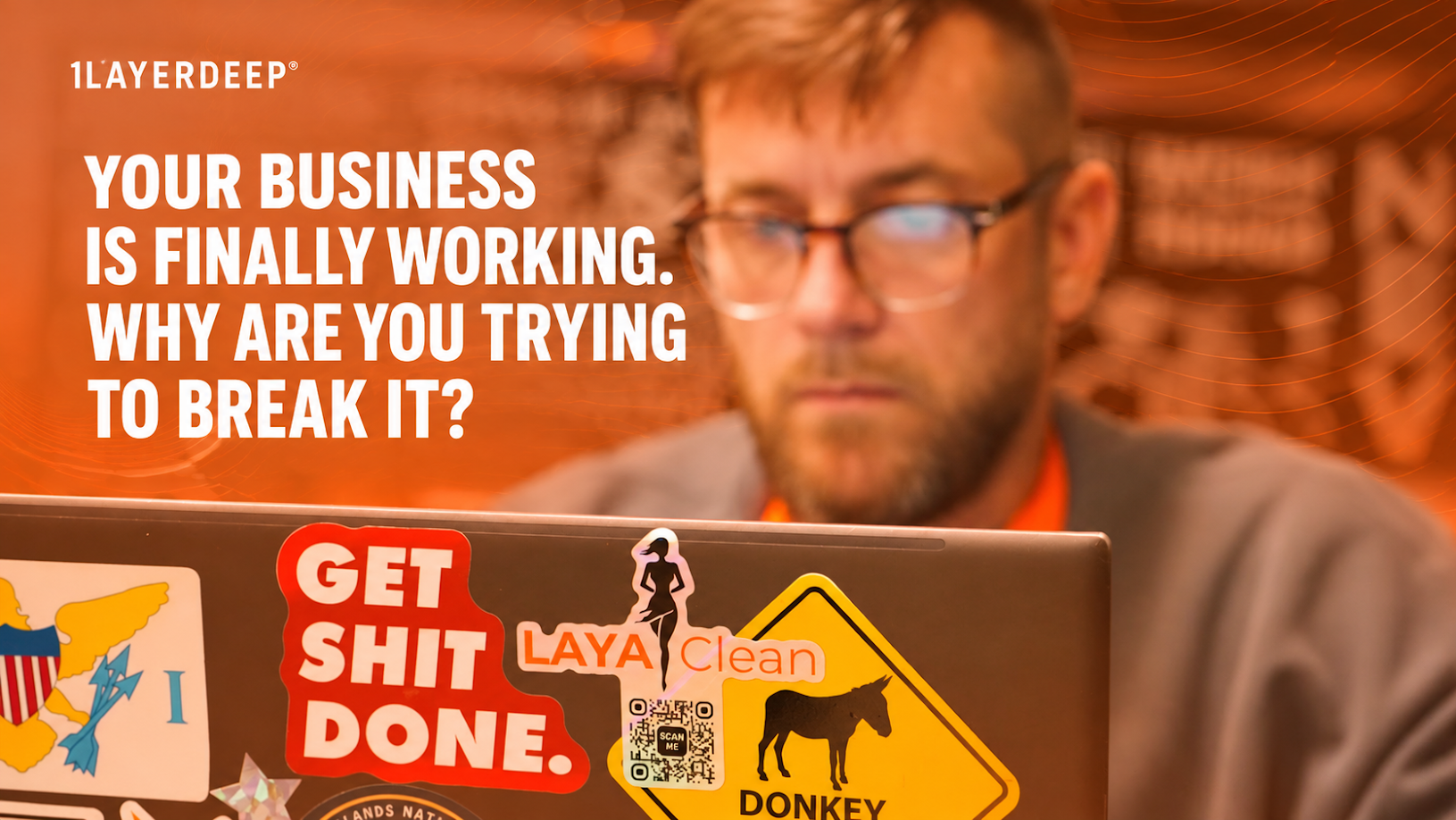
Some entrepreneurs are so addicted to solving problems that when the problems stop, they start creating new ones.
I know because I’ve been one of them.
We start businesses because we love building things.
We love challenges. We love figuring things out. We love being the person who can solve the problem nobody else can.
A customer is upset? We handle it.
An employee quits? We figure it out.
Something breaks? We’re already fixing it.
And after years of operating this way, something strange happens.
The business starts running without us.
The team handles the customers. The systems work. The phones aren’t ringing with emergencies every five minutes.
Everything we’ve been working toward is finally happening.
And instead of enjoying it?
We get bored.
Suddenly, we want to launch another service, change our software, reorganize the company, or start an entirely new business.
Not necessarily because the business needs it.
Because we need something exciting to do.
And that’s where entrepreneurs can become the biggest disruption in their own companies.
Maybe You’re Not Burned Out. Maybe You’re Bored.
During this week’s Q&A, Aaron and I talked about something I don’t think entrepreneurs discuss enough.
Burnout and boredom can look surprisingly similar.
Both can leave you feeling frustrated, unmotivated, or disconnected from your business.
But they don’t necessarily need the same solution.
When you’re burned out, even meaningful work can feel exhausting. You may need less pressure, better support, and real recovery.
When you’re bored, you might still have plenty of energy. It just shows up the second something new and exciting comes along.
Think about it.
You can’t bring yourself to finish the process you’ve been working on for three weeks.
But someone mentions a new AI tool, and suddenly you have six hours of energy to build something nobody asked for.
Sound familiar?
I’ve done it.
I once spent approximately $1,200 trying to create a specific piece of AI-generated video content.
I kept buying more credits, trying another prompt, and convincing myself I was almost there.
You know what I could have done?
Gotten out of my chair and recorded the footage myself.
I wasn’t solving a $1,200 problem. I was entertaining myself with a $1,200 distraction.
That’s an expensive way to avoid doing the simple thing.
Your Excitement Might Be Exhausting Your Team
Here’s the part that should make every business owner uncomfortable.
Your boredom doesn’t just affect you.
It affects everyone who works for you.
Imagine your team finally has a process working.
They know what to do. Customers are happy. The numbers are improving.
Then Monday morning comes.
You walk in with a brilliant new idea.
“We’re changing our CRM!”
“We’re adding another service!”
“We’re rebuilding the entire scheduling process!”
You’re excited.
Your team?
They’re exhausted before you’ve finished explaining it.
Because they know what comes next.
More meetings. More training. More changes. More unfinished projects.
And just when they figure out the new system, you’ll probably find something else.
Your need for excitement has become someone else’s unnecessary workload.
I used to be terrible about this.
Now, when I get an exciting idea, I’ve learned to write it down instead of immediately sharing it with the team.
Because not every idea deserves to become a project.
And not every project deserves to interrupt a business that’s already working.
The Business Might Have Outgrown Your Favorite Job
Aaron said something during our conversation that really stuck with me.
Maybe your business has outgrown your favorite job.
Think about that.
The work you loved when you started the company might not be the work the company needs from you today.
I love creating things.
I love building software, experimenting with AI, and solving complicated problems.
But yesterday, I spent almost my entire day in leadership meetings.
From 9 a.m. to 5 p.m.
Was that as exciting as building something new?
Not always.
But that’s what my businesses needed from me.
They needed someone setting priorities, making decisions, and helping the team execute.
The brain that helped you start your business isn’t necessarily the same one that will help you scale it.
Starting rewards creativity, speed, and the willingness to jump into anything.
Scaling requires consistency, patience, accountability, and sometimes doing the same boring things exceptionally well.
And if you refuse to make that transition, your business can remain dependent on you long after it should have learned to operate without you.
What If Growth Isn’t What You Actually Need?
Here’s another uncomfortable question.
Why are you trying to grow?
I recently spoke with a business owner who wanted to reach $2 million in revenue.
I asked her why.
She didn’t really have an answer.
She already had a business that supported a good lifestyle.
But $2 million sounded like the next goal.
And that’s what we do as entrepreneurs.
We hit $500,000 and want $1 million.
We hit $1 million and want $2 million.
Then $5 million.
Then $10 million.
But somewhere along the way, we forget to ask what we’re actually building all of this for.
I’ve experienced this myself.
Before Hurricane Ian, my cleaning company was doing approximately $2 million in revenue.
And we were chaotic.
The systems weren’t keeping up. The business demanded too much attention.
After the hurricane, we had to rebuild.
And we made a decision to prioritize stability.
Today, Organize It operates at a smaller revenue level than it did before the hurricane, depending on the season.
But it’s a business I can step away from.
And that matters more to me than chasing a bigger number just because I can.
A $1.5 million business that supports your life may be worth more to you than a $2.5 million business that consumes it.
That doesn’t mean you shouldn’t grow.
It means growth should have a purpose.
And you don’t have to spend every quarter in growth mode.
There can be seasons for growth, seasons for stability, and seasons for rest.
All three can be intentional.
Time Audit Template Worksheet
Before you start another project or decide your business needs a major change, take a look at where your time is actually going.
Our existing 1 Layer Deep® Time Audit Template Worksheet helps you record your activities, how long they take, whether they’re urgent, and whether someone else could handle them.
ACCESS THE FREE TIME AUDIT WORKSHEET →
Here’s my challenge: Track your work for one week.
Then look at the results.
Are you spending your time leading the business?
Or are you still jumping into problems your team should be able to solve?
Are you working on the things that move the company forward?
Or are you filling your days with projects that make you feel productive?
Sometimes the best next step isn’t adding something.
It’s getting yourself out of something.
Build a Business That Supports Your Life
Chris and I recently finished our annual planning.
And we don’t start with revenue goals.
We start with ourselves.
What do we want personally?
What do we want for our marriage?
What do we want for our family?
Then we ask what the businesses need to provide to support that life.
Because if you do it backward, you end up building your entire life around the demands of your business.
And that’s not why most of us became entrepreneurs.
My word for 2027 is FOCUS.
Not more businesses. Not more distractions. Not more projects just because they sound exciting.
Focus on the things that matter.
So before you make another big change, ask yourself:
Is my business actually broken, or am I just uncomfortable because it no longer needs me to fix everything?
Maybe you need rest.
Maybe you need a meaningful new challenge.
Maybe you need to become a better leader.
Or maybe, for the first time in years, you need to let something work without touching it.
Don’t confuse the absence of chaos with the absence of progress.
Sometimes the greatest sign that your business is growing up is that it no longer needs you to rescue it.
And the greatest sign that you’re growing as a leader?
You finally know when to leave it alone.
Less layers. More results.
Stay In The Loop
Get one insight each week on hiring, systems, and clarity.
Build a business that works without you in every layer..
Join the private 1 Layer Deep™ Operators Facebook group for service-based business owners who want simpler systems, clearer execution, and less chaos inside the business.
See how owners are applying 1 Layer Deep™ using LAYA, microplays, gameplans, and real-world examples.